

How We Achieved 67% Cost Savings by Automating Load Information Management for a 3PL Logistics
Our client is a leading 3PL solution provider that combines innovative technology with a customer-centric approach to deliver best-in-class logistics...
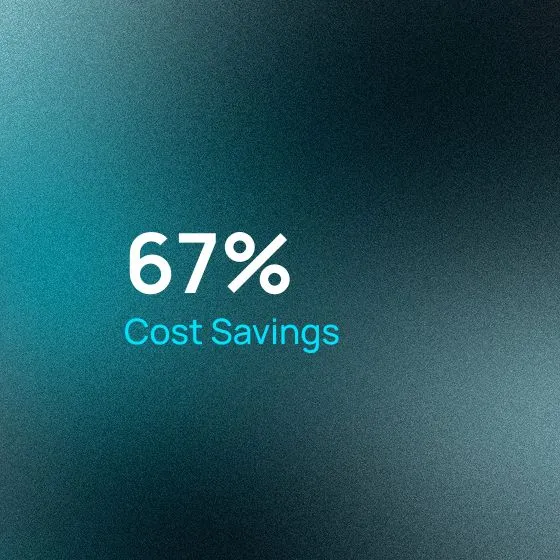
At a Glance
Our client is a leading 3PL solution provider that combines innovative technology with a customer-centric approach to deliver best-in-class logistics services to its clients. The offerings include transportation management, intermodal services, truckload services, etc. across a wide range of industries, including retail, manufacturing, food, beverage, and more.
Challenge
Manual processing of load information management by referring email chains
- The legacy transport management system (TRITAN) required manual intervention for maintaining load information.
- Inefficient container traceability – To ensure that containers are shipped on time, the operations team tracked around 200+ items on daily basis. The system only shows tracking details in TRITAN based on the load delivery date range. To maintain proper container track events, the delivery range needs to be updated from current date + 10 days. Manually updating the large volume of items is a tedious and time-consuming task, leaving room for missed values and loads not being maintained in track for visibility. If delivery date ranges are not updated correctly, this can lead to missed opportunities for visibility and an increased risk of damaged or lost cargo.
- Lack of free day closure visibility - If the load's last free days (LFD) details are not accurately reflected in TRITAN, the operation team will not have visibility on the container status, which led to delays, missed opportunities, and financial losses. This was challenging with large volumes of items involved (300+ approx. on daily basis), as updating each load's LFD details manually can be time-consuming.
- Error-prone invoice update process - The team was manually updating the storage charges based on the email attachments to the Tritan system. The storage charges are incurred as soon as the container arrives at the destination ramp & a notification will be sent to pick up the next container. However, if a pick-up is not completed on or before free days, these storage charges continue to accumulate, leading to unnecessary costs until the container is outgated. Furthermore, if the invoice details are not uploaded correctly and on time to the TRITAN system, the payment process can be delayed and break vendor relationships.
- The client decided to automate the load information management & storage cost invoice modification by developing a bot to increase efficiency, reduce errors, notify last free days, and free up valuable human resources.
Solution
End-to-end automation of load information management that improves on-time shipment pickup & storage charges reduction.
- The client collaborated with our RPA team & brainstormed possible automation solutions.
- We leveraged robotic process automation (RPA) to automate the manual process of maintaining load information in the legacy transport management system. The solution included the following steps:
Delivery date extension from emails – Our team built a bot to automatically extend the delivery date in the Tritan system, enabling operations to track containers & proactively plan the shipment delivery schedule and minimize delays. - Notification of last free days – We built bots to extract data from emails to identify the last free days for containers. The bots were configured to send automated notifications to the operations team and customers, to alert them about the impending expiration of the last free days.
- Updating prolonged storage charge invoice details – We developed a bot that extracted data from mailbox to identify containers that exceeded the last free days. The bots were programmed to automatically update the prolonged storage charge invoice details in the Tritan system, including the calculation of charges based on the duration of prolonged storage and the applicable rates.
Overall, the load information management processes such as notifying the last free days for containers, updating the prolonged storage charge invoice details, and the delivery date extension from the emails were completely automated.
Benefits
62% reduction in prolonged storage charges & 87% on-time delivery of containers
- On-time invoice generation to pay vendors.
- Enhanced load traceability with delivery date extension.
- Reduction in storage costs by last free days notification.
- Reduction in manpower, infrastructure, & 24/7 support.
Ready to transform
your enterprise?
Let's build something that lasts. Our team is ready to talk.